What is MND?
MND is the short term for motor neurone disease, which affects the nerves known as motor neurones. These nerves are found in the brain and spinal cord and they help tell your muscles what to do. If you have MND, this means your movement will be affected and you are likely to get a wide range of symptoms. Select from the following for basic facts about the disease.
Basic facts about MND
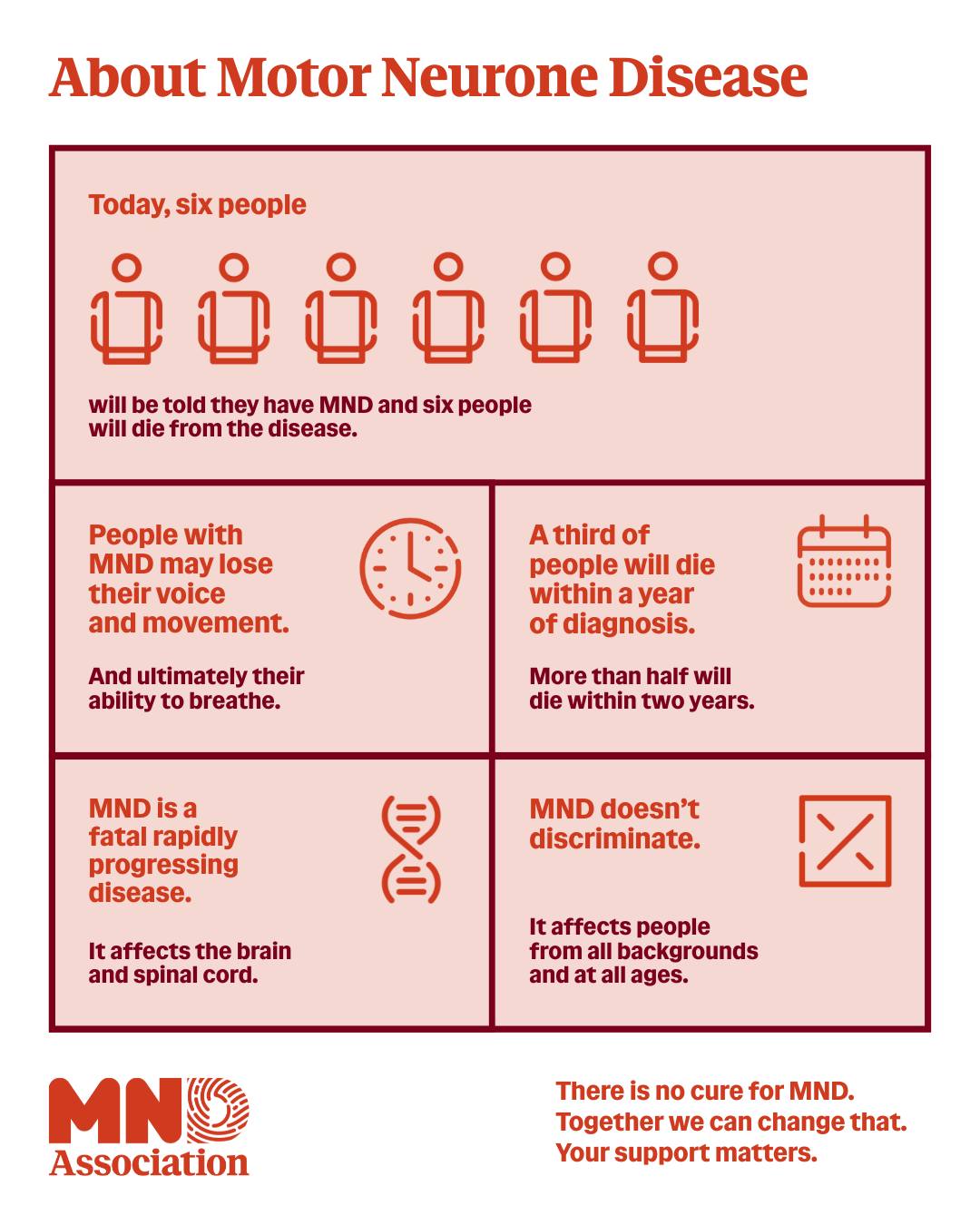
With motor neurone disease, known as MND, messages from the motor neurones gradually stop reaching the muscles. This leads the muscles to weaken, stiffen and waste, which can affect how you walk, talk, eat, drink and breathe. Some people also get changes to their thinking and behaviour, but the disease affects everyone differently. Not all symptoms will affect everyone, or in the same order. Symptoms also progress at varying speeds, which makes the course of the disease difficult to predict.
MND is life-shortening, and there is no cure. Although the disease will progress, symptoms can be managed to help achieve the best possible quality of life.
How many people are affected?
MND affects up to 5,000 adults in the UK at any one time. There is a 1 in 300 risk of getting MND across a lifetime. It can affect adults of any age, but is more likely to affect people over 50.
We provide further statistics if you would like more detail, but please be aware that these contain sensitive content.
As motor neurone disease is not common, general health and social care professionals may not see many cases. This means it is important to seek out specialists who have appropriate experience in its treatment and care, usually with referral to neurological services. For more information, see our pages about health and social care services with MND.
For further information on MND, please visit our charities main website:
https://www.mndassociation.org/about-mnd/mnd-explained/what-is-mnd